
Launch of the Three New Standards for the Agrifood Industry!
The SMF-Standards Development Organisation (SMF-SDO) launched three standards for the agrifood industry at the Agri-Food Tech Expo Asia on 28 October 2022.
The SMF-Standards Development Organisation (SMF-SDO) launched three standards for the agrifood industry at the Agri-Food Tech Expo Asia on 28 October 2022.
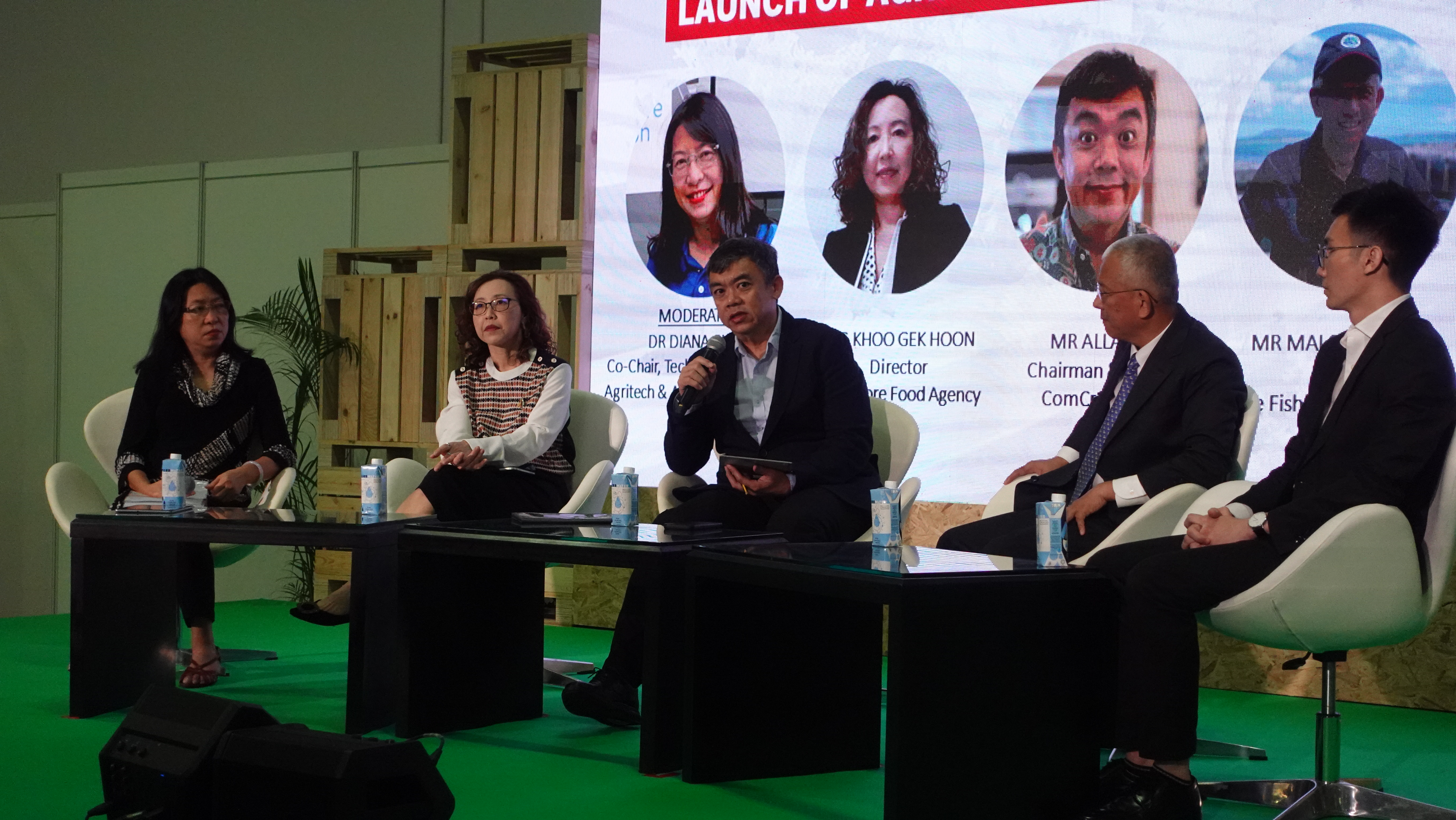
Industry speakers had a panel discussion towards the end of the launch.(From left to right): Dr Diana Chan (Co-Chair, Technical Committee for Agritech & Agrifood Production) who moderated the panel discussion, Ms Khoo Gek Hoon (Director, Industry Development and Community Partnership Division, SFA), Mr Allan Lim (CEO, ComCrop Pte Ltd), Mr Malcolm Ong (CEO, The Fish Farmer Pte Ltd) and Mr Yeap Soon Ming (QA Lead, Chew's Agriculture Pte Ltd).
Since the launch of the ’30-by’30’ goal in 2019 by the Singapore government, which is to build up Singapore’s agri-food industry’s capability and capacity to produce 30% of Singapore’s nutritional needs locally and sustainably by 2030, the number of local farms has grown from 221 in 2019 to 260 in 2021. As of 2021, the local agri-food sector was predominantly made up of farms producing eggs, seafood, and vegetables, contributing 30%, 8%, and 4% of Singapore’s total food consumption. The total value of local food production of these items increased 13%, from $163.4 million in 2020 to $185.2 million in 2021[1].
With a growing market volume and increased number of farms in Singapore, it was time for the industry to look at building its capabilities and improving farm management – important aspects for overall food safety and quality.
Hence, the three Singapore Standards (SS), which are namely:
·SS 670 Specification for good aquaculture practice,
·SS 675 Specification for good agriculture practice; and,
·SS 676 Specification for good animal husbandry practice for layer farms,
were developed to guide Singapore’s local farms in the areas of safety and quality, environmental management, and, the health and safety of farm workers. Through the adoption of best farming practices recommended by local industry experts and the alignment with international standards, these Singapore Standards will allow local farms to access wider markets and enhance consumers’ confidence in the farms’ products and produce.
During the launch, industry speakers from the Singapore Food Agency (SFA), ComCrop Pte Ltd, The Fish Farmer Pte Ltd and Chew’s Agriculture Pte Ltd shared the scope and objectives of the three Singapore standards. They also shared how the standards can play a part in promoting good agricultural, aquacultural and animal husbandry practices in the farm management system.
The three Singapore standards are available for purchase at the Singapore Standards eshop. Go to www. singaporestandardseshop.sg to purchase a copy.
SS 670:2021 Specification for good aquaculture practice
This standard provides a set of requirements for a farm management system that includes best practices to ensure the production of high-quality and safe produce during all phases of farm operations while minimising impact on the environment and upholding the welfare of aquatic animals.
This standard applies to open-cage farming, pond farming, and closed containment farming systems for fish, crustaceans and molluscs.
SS 675:2021 Specification for good agriculture practice
The standard provides a set of requirements for a farm management system detailing best practices to prevent the risk of hazards from occurring and ensuring the production of safe and high-quality produce, while minimising the impact on the environment and workers.
The standard covers all phases of farm operations, including pre-production (nursery), cultivation, harvesting and post-harvest handling prior to delivery of agriculture products for both outdoor and indoor farming. This standard applies to vegetables, fruits and herbs farms.
SS 676:2021 Specification for good animal husbandry practice for layer farms
The standard provides a set of requirements for a farm management system detailing best practices to ensure the production of safe and high-quality produce during all phases of farm operations, including pre-production (e.g. hatchery, breeder stock and pullet), production (e.g. laying stages), egg collection, and post-production (e.g. management of spent birds, etc.), while minimising the impact on the environment and upholding the welfare of animals. It applies to chicken layer and quail layer farms.
Other News
-
Dec 04, 2024
Timor Leste Trade and Investment Forum 2024: Strengthening ASEAN Ties
-
Nov 29, 2024
China-Singapore Guangzhou Knowledge City Event
-
Nov 28, 2024
Stephen Ibaraki on the 10th Machine Age