
Standards for Safe and Effective Adoption of Robotics Solutions
With the increased emphasis to apply automation and robotics as a manufacturing solution to address the shortage of manpower and productivity issues, the Manufacturing Standards Committee (MSC) managed by SMF-SDO organised a workshop on safe and effective adoption of robotics via standards.
28 February 2017 - With the increased emphasis to apply automation and robotics as a manufacturing solution to address the shortage of manpower and productivity issues, the Manufacturing Standards Committee (MSC) managed by SMF-SDO organised a workshop on safe and effective adoption of robotics via standards. The workshop was attended by 29 participants from 17 organisations.
Robots, which come in a variety of shapes, sizes and configurations, with performance range from carrying, moving packing, welding and assembling are now witnessing applications in non-manufacturing industry sectors such as retail service and hospitality. As robots are increasingly perceived as potential robots working collaboratively or side by side with humans, it is part and parcel of the future of manufacturing.
Mr Lars Skovsgaard, Convenor of the Industrial Robots Working Group who’s also Managing Director of Zacobria Pte Ltd highlighted that “with the global robotics industry growth, it is imperative to increase the understanding of safety risk assessment and implementation of industrial robots to ensure workplace safety” and therefore the organization of such a workshop is highly useful. MSC has recently adopted ISO 10218-1:2011 (Robots and robotic devices — Safety requirements for industrial robots — Part 1: Robots), ISO 10218-2:2011 (Robots and robotic devices — Safety requirements for industrial robots — Part 2: Robot systems and integration) and ISO/TS 15066:2016 (Robots and robotic — Collaborative Robots) as Singapore Standards and Technical References and these were elaborated during the workshop.
“Standards are important because they are developed by robot manufacturers, integrators and worldwide standard organisations, and thereby represent a high level of expertise and experience. Standards also provide a guideline on developing and sustaining a coherent and effective risk assessment programme,” said Mr Skovsgaard.
MSC will continue to identify and conduct future workshops on service and personal care robots.
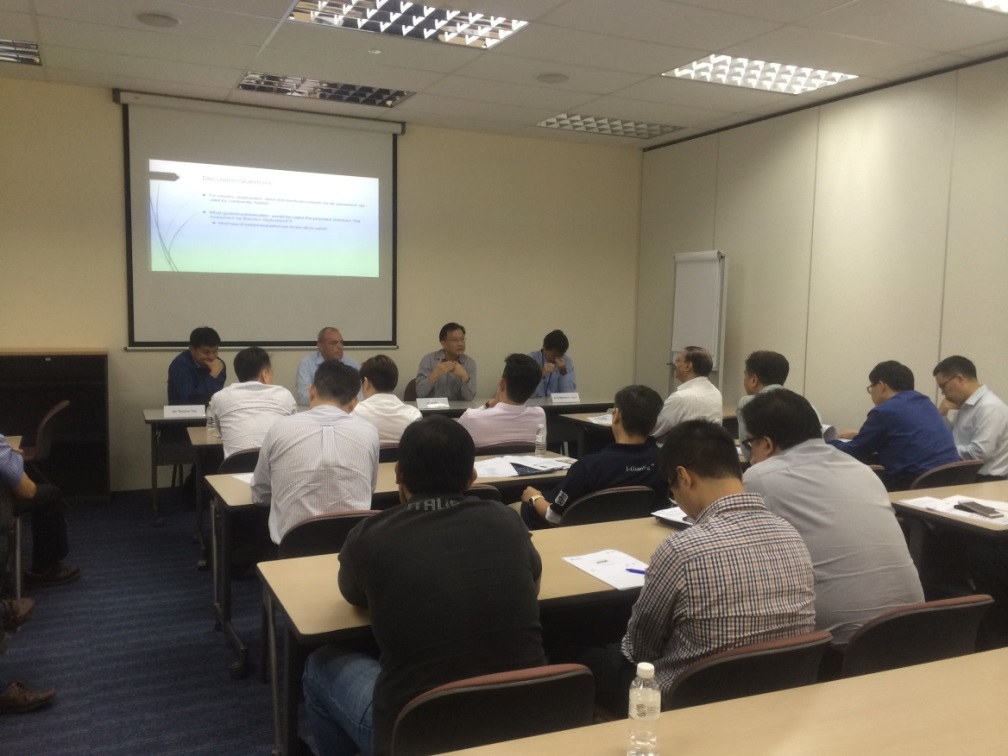
An engaging dialogue session between the panellists and workshop participants on robotic safety and its implementation.
Other standards workshops completed from December 2016 – February 2017 include:
1) Manufacturing Standards Committee (MSC) Standards Adoption Workshop on TR46 : 2016 Last mile Delivery – eCommerce Data Interchange (15 Dec 2016)
2) General Engineering & Safety Standards Committee (GESSC) Standards Adoption Workshop on Singapore Standards on Safe Use of Lifting Equipment (20 Jan 2017)
3) Biomedical Standards Committee (BMSC): Standards Adoption Workshop on Impact of ISO 13485:2016 on medical device quality management systems (10 Feb 2017)
4) General Engineering & Safety Standards Committee (GESSC): Standards Adoption Workshop on Singapore Standards related to Lifting Machines and Gear (22 Feb 2017)